7 Best Driveway Options For Every Home
13/05/2026

The construction landscape in India is evolving rapidly. Where once architects and builders defaulted to ceramic tiles or polished granite, a growing number are now specifying terrazzo — a material with centuries of history, reimagined for the demands of modern infrastructure.
Terrazzo tiles offer a unique combination of properties that few materials can match: exceptional compressive strength, a virtually unlimited palette of colours and aggregates, long service life, and a surface that only improves with age and polishing. It is no coincidence that airports, hospitals, townships, and luxury residential projects are increasingly turning to terrazzo.
At its core, terrazzo is a composite material. Chips of marble, quartz, granite, glass, or other aggregates are embedded in a cementitious or epoxy matrix, then ground and polished to a smooth, seamless surface. The result is a floor that cannot be replicated by any tile system — because it is cast and finished on site, in one continuous surface, with no grout joints to accumulate dirt or harbour bacteria.
For high-traffic environments — hospitals, airport terminals, shopping malls, municipal buildings — this is a critical advantage. Seamless floors are dramatically easier to maintain, resistant to microbial growth, and far more hygienic than alternatives with grout lines.
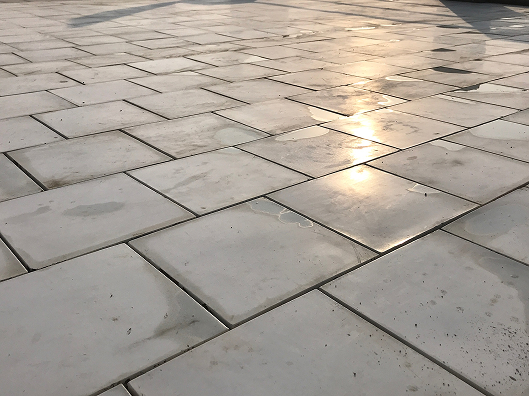
One of the most compelling arguments for terrazzo is its lifespan. Properly installed terrazzo floors in heritage buildings across Europe have lasted well over 100 years. In India, terrazzo floors from the colonial era remain functional and beautiful in many public buildings and railway stations.
Unlike ceramic or porcelain tiles that chip, crack, or lose their surface finish under sustained heavy load, terrazzo becomes part of the structural slab. Its compressive strength typically exceeds 40 MPa — comparable to the concrete beneath it. When surface wear eventually occurs after decades of use, a simple re-grinding and re-polishing restores the floor to its original condition.
"A terrazzo floor is an investment, not a specification choice. The lifecycle cost — when maintenance, replacement cycles, and downtime are factored — is substantially lower than any tile alternative."
Sustainability is now a core consideration in every significant project. Terrazzo tiles score well across multiple environmental metrics. Many formulations incorporate recycled content — post-industrial marble off-cuts, recycled glass, and GGBS (ground granulated blast-furnace slag) — reducing embodied carbon without compromising performance.
Mayur Dynamic's terrazzo range is manufactured in a facility committed to reducing waste and energy consumption at every stage of production. Products are tested and certified, with full technical data available for green building submissions.
Perhaps the most exciting development in terrazzo is the breadth of design possibilities now available. Advances in pigment technology, aggregate sourcing, and manufacturing precision mean that architects can specify virtually any colour, texture, or pattern — and receive a consistent, reproducible result at scale.
From the fine terrazzo of five-star hotel lobbies to the robust, slip-resistant surfaces of industrial yards, the same material family delivers. Custom divider strip layouts, inlaid patterns, geometric borders, and branded floor installations are all achievable within the terrazzo system.
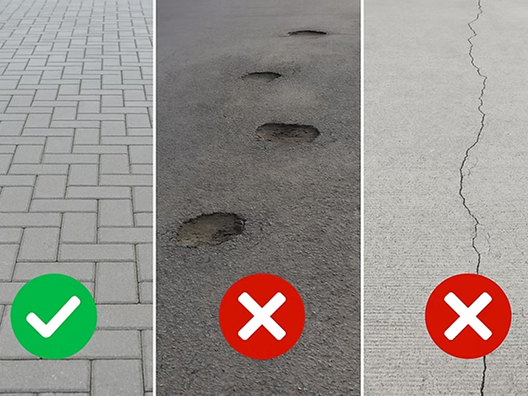
Municipal corporations and infrastructure bodies across India are specifying terrazzo for footpaths, public plazas, metro stations, and civic buildings. The combination of low maintenance cost, high durability, and local availability makes it ideal for public-sector procurement.
Developers building townships and residential complexes are increasingly using terrazzo in lobbies, corridors, and common areas as a differentiator — a signal of quality and long-term value to homebuyers.
Seamless, non-porous, chemically resistant surfaces are not optional in healthcare environments — they are mandated by good clinical practice. Terrazzo meets all these requirements and can be specified with anti-static properties for operating theatres and sensitive equipment areas.
Hotels, restaurants, and retail environments demand a surface that is visually distinctive, easy to maintain under heavy footfall, and capable of reflecting a brand identity. Terrazzo, with its bespoke design capability, is uniquely suited to this sector.
The quality of a terrazzo installation is only as good as the quality of the material and the expertise of the manufacturer behind it. At Mayur Dynamic, we have developed our terrazzo range over decades, refining formulations for Indian climate conditions, aggregate availability, and the specific demands of our diverse customer base.
Our technical team provides specification support from initial design through to installation completion — including aggregate selection, colour matching, divider strip layouts, and sealing recommendations. Every product is tested to relevant IS and EN standards before it leaves our facility.
If you are specifying a project where durability, sustainability, and design excellence all matter, terrazzo deserves serious consideration. We would be happy to discuss your requirements and provide samples, technical data, and pricing.